


Page 14 - Mines and Minerals Reporter eMagazine - Volume December 2024
P. 14
MINING GROWTH


            period of 70 years, this significant amount of deterioration has  that was shut down in 2002, have no option but to consume
            occurred. In 2007, the Blacksmith Institute of the US named  poisonous water and breathe in chrome dust. Every household
            the resource-rich Sukinda valley in Odisha as the fourth most  in the valley has members who are afflicted with diabetes,
            polluted region in the world. The state pollution control board  gastroenteritis,  and  skin  conditions.  At  least  two  cancer
            aggressively disputed the findings as greatly inflated, but they  sufferers reside in every community nearby mining area. One
            nonetheless  managed  to  spark  a  productive  discussion  on  local named Nayak started farming on his four acres of land
            environmental challenges in the area.                after losing his mining job, but the yield is still poor since the
                                                                 soil has been damaged. In addition to the 60,000 people living
                          ECOLOGICAL DAMAGE                      in the seven gram panchayats of Sukinda, the effects of mining
                                                                 have also directly impacted more than 40,000 people in five
            According to the Lokayukta Report, illegal mining has caused  additional  gram  panchayats  in  the  neighboring  Dhenkanal
            significant  ecological  damage.  In  the  Bellary  region,  certain  district.
            species  of  animals  have  vanished,  including  the  sloth  bear.
            The local medicinal plants no longer flourish. In the mining  The second-largest river in Odisha, the Brahmani, which flows
            region, the entire rainfall system has been altered. According  through the Sukinda valley, is the most polluted in the state
            to reports, the land surrounding the mining area is completely  as a result of excessive hexavalent chromium exposure, which
            devoid of vegetation and has no agricultural activities related  has  increased  the  danger  of  cancer-causing  carcinogenic
            traffic accidents, road damage, and fatalities. Road safety has  compounds for the 26 lakh river-dependent residents. Studies
            been negatively influenced by a lack of adequate regulation in  have  shown  that  chromite-related  disorders  are  to  blame
            the mining and transportation of iron.               for more than 80% of fatalities in extensively mined regions.
                                                                 Despite  claiming  that  the  Blacksmith  Institute  report  was
                        ONE INSTANCE OF ODISHA                   much  overstated,  the  state  pollution  control  board's  own
                        “SUKINDA” MINING REGION                  research likewise revealed significant amounts of hexavalent
                                                                 chromium  in  surface  water.  The  state  pollution  control
            About 97 per cent of the nation's deposits of chromite ore,   board's report stating that the PH and hexavalent chromium
            a  key  ingredient  in  the  creation  of  stainless  steel,  leather,   levels after treatment were within the limits specified under
            and alloys, are located in the valley in the Jajpur district of   the Environment (Protection) Rules was not accepted by the
                                                                 Orissa high court when it heard a writ suit in May of last year.
                                                                 After hearing a writ petition in May of last year, the Orissa
                                                                 high court requested that the central pollution control board
                                                                 conduct an independent investigation into Sukinda's pollution
                                                                 because  it  was  unsatisfied  with  the  state  pollution  control
                                                                 board's report that the pH and hexavalent chromium levels
                                                                 were  within  the  limits  set  by  the  Environment  (Protection)
                                                                 Rules, 1986. The central board issued its findings in October
                                                                 of  last  year,  noting  that  mining  for  chromite  had  increased
                                                                 hexavalent  chromium  contamination  and  recommending
                                                                 the formation of a partnership with representatives from all
                                                                 miners operating in the valley to take corrective action. Ranjan
                                                                 Panda, a well-known environmentalist and water campaigner,
                                                                 questions  the  effectiveness  of  the  collaboration  and  claims
                                                                 that local officials cannot escape accountability since without
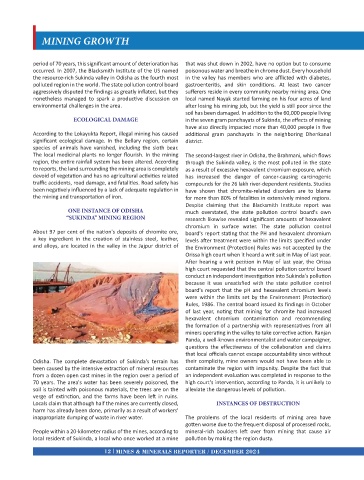
            Odisha.  The  complete  devastation  of  Sukinda's  terrain  has   their complicity, mine owners would not have been able to
            been caused by the intensive extraction of mineral resources   contaminate the region with impunity. Despite the fact that
            from a dozen open cast mines in the region over a period of   an independent evaluation was completed in response to the
            70 years. The area's water has been severely poisoned, the   high court's intervention, according to Panda, it is unlikely to
            soil is tainted with poisonous materials, the trees are on the   alleviate the dangerous levels of pollution.
            verge  of  extinction,  and  the  farms  have  been  left  in  ruins.
            Locals claim that although half the mines are currently closed,   INSTANCES OF DESTRUCTION
            harm has already been done, primarily as a result of workers'
            inappropriate dumping of waste in river water.       The  problems  of  the  local  residents  of  mining  area  have
                                                                 gotten worse due to the frequent disposal of processed rocks,
            People within a 20-kilometer radius of the mines, according to   mineral-rich  boulders  left  over  from  mining  that  cause  air
            local resident of Sukinda, a local who once worked at a mine   pollution by making the region dusty.

                                     12 MINES & MINERALS REPORTER / DECEMBER 2024

